March 2013
March is coming in like a lamb - more fine weather. However the long cold spell of late February is due to end soon with a probable and not unusual complication of damper conditions again. However the dry spell has been brilliant for doing lots of gardening, without mud, and I hope you have managed to be preparing your ground for spring. I noticed how even after one dry week, the surface of many beds could be raked lightly to break up surface lumps, and it is now time for a few early sowings.

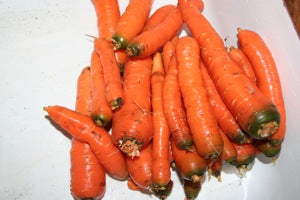
Carrots before and after brushing.

They are stored in a paper sack in the garage, soil keeps them firm and sweet.

On the greenhouse hotbed I have a pallet with many seed trays and, despite the cold, seedlings are growing.

The hotbed is over 30C just two inches below its surface but this appears to give less warmth to the trays above than an electric heat mat

The garden is taking shape!

Look closely to see the difference: a bed of compost before...

...and after raking its surface, woody bits flicked into the paths.

These salads have all been in the greenhouse at Lower Farm over winter

and are now growing at Homeacres!
First sowings
Spinach is one of the best vegetables for an early outdoor sowing. Look for seed of longer lived varieties, such as Toscane and Boa F1, so that harvests are over months rather than weeks, even into June. If you like green spinach leaves in summer, sow leaf beet in April to crop when the true spinach has gone to flower, although leaf beet’s flavour is less impressive than real spinach. Leaf beet and chard are better sown in April than March, to reduce bolting, and ruby chard in particular is better sown in May if you want it through summer and into autumn.
The calendar of sowing in spring is a long one with considerable waiting for best dates to come round. Don’t feel pressured if your allotment neighbour is making earlier sowings than you because it is often the later ones that do better in the end. After spinach the first vegetables to sow outdoors, from mid March, are radish, parsnip, lettuce, pea, brassicas of early varieties, onion, salad onion and carrot. All can be covered with fleece and will be much helped by that. All these vegetables except carrot and parsnip can also be sown undercover in modules and then planted in April. Indoor sowings now include tomato, pepper, chilli, aubergine, and celeriac, with some extra warmth if possible, so the first fortnight on a windowsill is worthwhile. Also beetroot in modules, four seed to each and thinned to four plants per module.
First and second early potatoes also want planting now. My favourite way is to make a small hole with a trowel to pop them in about one inch deep, then "earth up" with extra organic matter, which can be less well rotted compost and manure, depending what you have available.
So there is plenty to do without even thinking of sowing climbing beans, sweetcorn, courgettes and squash: keep them for sowing later when it is warmer.
Progress at Homeacres
I have been surprising myself with the amount of new beds here and almost every one is different. With help from Josh, a keen young gardener who is also doing a monthly trial of different ways of living and eating (http://vimeo.com/iwanttoliveinavan), we made a bed of municipal green waste compost and used a lot of it to mulch a bed between fruit trees. That one, with plant fabric on top, is now planted with alpine and everbearing strawberries.

Beds on grass, filled with different composts using a wooden framework to hold the shape while being filled

Cardboard is only along the edges and not under the main part of each bed

Dark bed is municipal compos

Middle bed has soil and manure, end bed with strawberries is just manure.
Then Steph helped to mulch another bed between other apple trees and I shall probably plant a few squashes there.

Spreading municipal (green waste) compost on grass between fruit trees

Landscape fabric on top and these are alpine strawberries which Steph sowed last autumn

Rather than mow between the trees

I am spreading some quite fresh horse manure and then green waste compost on top

We buried the fabric's edges into slits in the soil.

This should make it easy to mow grass close to those edges.
Around the greenhouse was a muddy, squelching mess after all the building work and erection on 11th (see February). I was wondering how to grow anything there and when showing some course participants the muddy mess, I thought to dig up a clod of soil to find out what it looked like under the compacted surface. In fact, the pasture roots and worm channels were still intact, from two or three inches down, so I just put compost on top and trust worms and other soil life to heal the damaged layer which is now about eight inches down! I had not meant this bed to be so deep but it kept on growing! It will be an interesting comparison with the beds of thinner mulch beyond.

The muddy mess on February 15th

On which I put lots of different composts

About two thirds green waste compost and one third cow manure

With a little home made compost in the foreground
Two beds beyond the greenhouse have less compost on, a mere three inches or so, and are covered on top with either black polythene, green polythene (from a friendly farmer’s old sheep polytunnel) and cardboard. This sequence has twelve photos to give you a good idea of how the beds were created.

Before starting, grass and weeds, all subdued by frost.

Then I checked the width of my black polythene & carded the path

This is four barrow loads of compost (green waste)

And cow manure on each bed of twenty feet by three and a half

The cardboard bed also had a little topsoil since the soil heap was so close

Green waste compost on top

I am not sure whether I shall be planting through the polythene and cardboard

It depends how much couch grows....

Mick Denney helped fetch some compost I made last summer, full of worms

That is in the final section of beds.

Again we capped it with green waste compost, put a sheet of plywood on top and walked on that to smooth it down

Then laid the groovy green plastic on top! Under the stones in the middle are small holes cut in the plastic to let water through
Another bed has four inches of manures and compost on grass, with a strip of cardboard along both edges to keep grass at bay there, and I covered that bed with plant fabric as a kind of safety measure in case the four inches is too little for buttercups and perennial grasses.
Just for a change, I bought a mushroom kit from www.organiccatalogue.co.uk with three kinds of spawn on wooden dowels. Then on reading the instructions, I realised that it is a major project to plant and look after the mycelium. First I took a wheelbarrow into a distant field to cut a low branch off an oak tree. Then drilled 9mm holes for the fungi-carrying dowels, then Steph covered the dowels and other wounds with ultra hot wax, then I put the logs in black polythene sacks and buried them in a shady spot for at least six months. Just a beginning…. more on this in the autumn, I hope!

I am drilling holes in freshly-cut oak

Then pushing the dowels in with their mycelium growing on them

So the fungi should now colonise this wood

After all holes have been sealed with hot wax, sorry about the pic!
Updates from March 15th 2013.
The cold weather has certainly been severe for mid March, a reminder of how fortunate we have been in recent years, decades even, to have milder early springs. Currently it is turning less cold but also wet so that is no better!

Still time to prune: I took a saw to the Bramley tree and thinned out many crowded branches.

Afterwards...

While up the ladder atop the Bramley I saw chance to take these pics of Homeacres.

Perennials, mulch and hotbeds.
Planting 8th March
However it may warm up and become a little more spring-like around the equinox and perhaps it may dry up again around the full moon on 27th, maybe Easter will even see nice weather. One has to hope. The month’s last week is good time for planting onion sets, potatoes and more lettuce, salads outside. There is no rush at this time of year for most other sowings and plantings. However it is a good moment for sowing celeriac and celery, as long as you can offer some warmth, so a windowsill is excellent for them.
I already planted some early potatoes on the second hotbed and some salads in a small bed where peas for shoots, spring onion, spinach and lettuce are planted together, with fleece on top. Normally I would be planting early cabbage and calabrese at this time but a combination of cold weather and not having a greenhouse until a month ago has been tricky.

Before and after raking a bed with cow manure on top.

Manure had dried and softened, there is a good tilth.

While dibbing it was good to see some earthworms!

Then I planted with the plants not hardened off, but...

Plants immediately covered with fleece.

I spread dried seaweed on the left hand bed, as a comparison.
Hotbeds 2
I wish I had fleeced my overwintered salads outdoors, which looked fine until Monday 11th, when they were shrivelled by a bitter northeasterly gale, an exceptional wind, the winter’s coldest day. The salad which survived best is good old lambs lettuce.

Making a second hotbed on 1st March

Using pallets to contain more depth of manure than my first hotbed

Rare sighting of a tractor at Homeacres!

Then I filled the rest with wheelbarrow, Jenny's horse manure is one to four weeks old.

I really piled in the manure then closed the gap.

Levelled it off and trod it down well for a good ten minutes.

Next step is to place a wooden bed on top of the manure (I brought this one from Lower Farm).

Fill it with well decomposed manure and compost.

The last layer is two inches of my precious home made compost which I also brought from Lower Farm.

Now ready to sow...

Sowed with carrots, spinach, beetroot, spring onion, radish, also planted peas, lettuce, radish, potato

Then covered with cloche hoops and fleece, which stayed on in the gales thank goodness, weighted with wood and stones

Meanwhile the first hotbed has a nice selection of seedlings growing

Including carrots, peas and spinach
Greenhouse
It made the greenhouse an attractive place to be with a maximum on that day of 12C, compared to 0C outside. However the difference by night is much less pronounced: for example on 14th it was -7C outside (winter’s lowest temperature here, in mid March!) and -5C in the greenhouse, so I am glad to have plants growing on top of the hotbed, Tomato seedlings are in the middle and I laid fleece on them overnight. A friend nearby left her tomato plants in an unheated greenhouse and they were frazzled; if plants freeze, it is a lot of effort and expense lost. In a frost of -2 or -3C, the greenhouse holds just enough heat overnight but keep an eye on the forecasts in case another severe frost is predicted.

This ice covered water was inside the greenhouse.

But the plants were fine, on a hotbed and covered with fleece overnight.

After removing the fleece, they look good (14th March).

The chard is from a root I dug out and potted up in November, for salad leaves through winter and there have been plenty (it was in the greenhouse at Lower before).
More mulching
I have finished mulching all the recent plantings of fruit trees, using combinations of manure, compost and cardboard, with landscape fabric on top. The fabric does not kill weeds because it lets some light through but should prevent weed growth when combined with the other coverings underneath it. Also it stops blackbirds from scattering the manure.
Other news from Homeacres
There has been sudden and rapid progress of the conservatory, after the oak pillars and beams finally arrived. Mark has been working steadily and rapidly so these pictures span only five days, once I had treated the timbers with OSMO UV protector.

The difference in colour, before and after treating the window frames.

Green oak, very heavy! ably lifted by Mark's dad

Mark and Jed placing the beams and frames on Saturday 9th


Mark and father Norman on a bitter day

Suddenly the roof is on and Velux windows installed

Interesting to compare light levels, before and after they put the roof on! But with a glass roof it would become extremely hot in sun, and colder in winter too.

I want to start seedlings by the windows, perhaps grow cocktail cucumbers too, we shall see....

Starting with grass and weeds (and recently sown grass)

Cardboard and green-waste compost on top

Five barrowloads of compost will allow plantings of winter squash etc

Through holes in the fabric.